
For Canadian businesses operating across the U.S. border, currency fluctuations can have a significant impact on profitability, purchasing power and cash flow.
When the Canadian dollar weakens against the U.S. dollar, businesses that rely on American suppliers, purchase inventory in USD or pay for services south of the border face an immediate increase in costs when those expenses are converted back into Canadian dollars.
Recent currency movements highlight just how quickly conditions can change. According to a November report by Reuters, the Canadian dollar was trading at approximately C$1.4135 per U.S. dollar, remaining close to an 18-day low. The report attributed the currency’s weakness partly to falling oil prices and recent Canadian employment data, which tempered expectations of further Bank of Canada interest rate increases.
For Canadian businesses purchasing goods, materials or services from U.S. suppliers, movements like these can have a direct impact on operating costs and working capital requirements.
While a weaker Canadian dollar can benefit exporters and businesses earning revenue in U.S. dollars, the picture is more complicated for companies with costs and revenues in different currencies. Even businesses experiencing healthy sales growth can find themselves under increasing working capital pressure as they navigate changing exchange rates.
For small and medium-sized enterprises (SMEs), which often have less financial flexibility than larger corporations, these pressures can be particularly challenging.
Understanding how currency movements affect business finances is an important first step in protecting margins, maintaining liquidity and planning for continued growth.
Which SMEs Are Most Exposed to Currency Fluctuations?
Not every business experiences a weaker Canadian dollar in the same way. The impact depends largely on where a company generates revenue, where it purchases goods and services and which currencies it uses to meet its financial obligations.
Some of the businesses most exposed to exchange rate fluctuations include:
Importers and distributors: Canadian businesses purchasing inventory, equipment, raw materials or finished goods from U.S. suppliers must account for higher Canadian-dollar costs when the loonie weakens.
Manufacturers: Companies relying on U.S.-sourced components, machinery or production materials may see their input costs increase, particularly when supplier agreements are priced in USD.
Wholesale and retail businesses: Distributors and retailers importing products from the United States may face higher inventory acquisition costs, putting pressure on margins if selling prices cannot be adjusted immediately.
Transportation and logistics companies: Businesses operating across the border may have expenses denominated in U.S. dollars, including fuel, equipment, maintenance and third-party services.
Canadian businesses expanding into the U.S.: Companies establishing American operations may need to fund payroll, premises, inventory and other operating expenses in USD before their new market generates sufficient revenue.
For these businesses, currency movements can create a mismatch between the timing and value of incoming and outgoing payments.
The Hidden Impact on Profit Margins and Working Capital
One of the biggest challenges associated with a weakening Canadian dollar is that its impact extends beyond the exchange rate itself.
Consider a Canadian distributor purchasing $100,000 USD of inventory from an American supplier.
If the exchange rate moves from CAD $1.35 to CAD $1.40 per U.S. dollar, the Canadian-dollar cost of that purchase increases from $135,000 to $140,000.
The following example illustrates how even a relatively small exchange-rate movement can affect the amount of working capital a business needs.
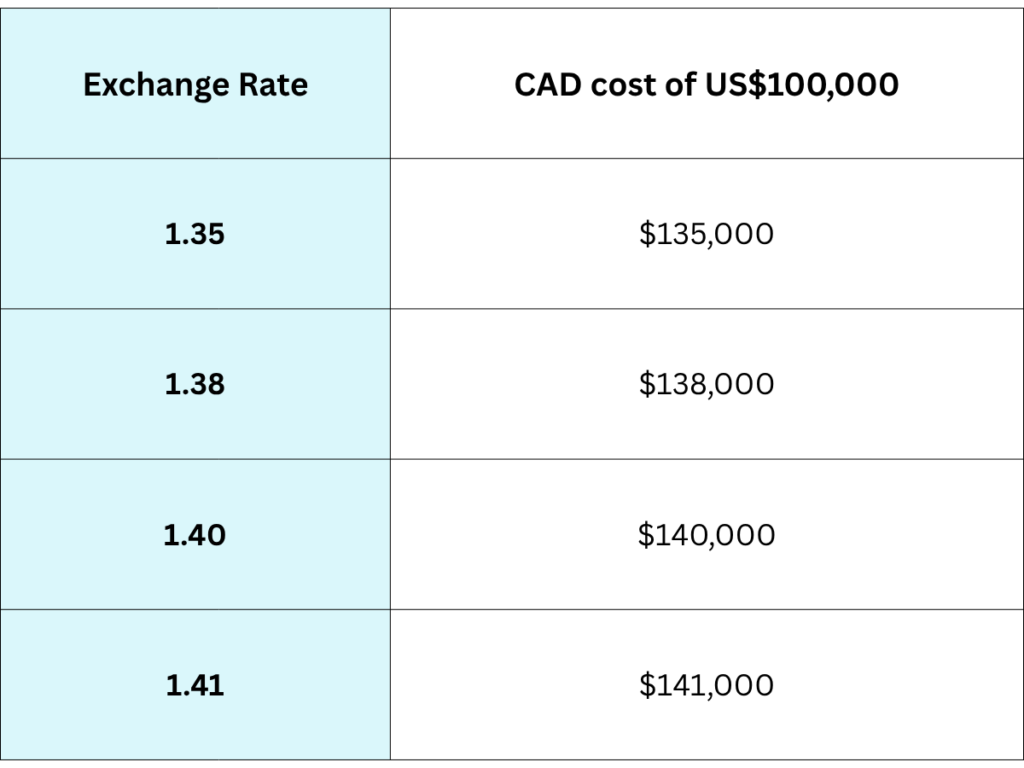
A six-cent movement in the exchange rate adds $6,000 to the cost of the same inventory purchase. For a business placing multiple orders throughout the year, these additional costs can quickly accumulate.
The challenge is that higher purchasing costs do not always translate into higher selling prices. Businesses operating in competitive markets may have limited ability to pass those increases on to customers without risking sales volumes or losing market share. This can result in margin compression, leaving less cash available for payroll, supplier payments, operating expenses and future investment.
There is also a timing issue. A business may need to pay its U.S. supplier weeks or months before it receives payment from its own customers. When the cost of replenishing inventory increases, more working capital is required to maintain the same level of operations.
For growing SMEs, this can create a cash-flow squeeze even when the business remains profitable and customer demand is strong.
Not All Businesses Lose Out When the Dollar Weakens
It is important to recognize that a weaker Canadian dollar does not necessarily create difficulties for every cross-border business. Canadian exporters and companies earning revenue in U.S. dollars may benefit when those earnings are converted back into Canadian dollars. Their products and services may also become more competitively priced for American customers.
For example, a Canadian manufacturer selling products to U.S. customers and receiving payment in USD may see the Canadian-dollar value of its receivables increase as the exchange rate moves in its favour. However, the benefits depend on the company’s overall currency exposure.
An exporter that receives USD but also purchases raw materials, pays suppliers or operates facilities in the United States may find that higher expenses offset some of the additional revenue. The key is understanding the relationship between incoming and outgoing payments, rather than looking at the exchange rate in isolation.
Businesses with operations on both sides of the border should regularly review their currency exposure, payment schedules and working capital requirements to ensure they are prepared for changing conditions.
Managing Cash Flow When Purchasing Costs Increase
Currency fluctuations are just one of several external pressures facing businesses operating across the Canada–U.S. border. As explored in our earlier insight, How the US-Canada Trade War Is Impacting SME Cash Flow, changing trade conditions, tariffs and supply chain uncertainty can also create additional costs and complicate financial planning for SMEs. When these pressures coincide with a weakening Canadian dollar, the impact on working capital can become even more significant.
While businesses cannot control foreign exchange markets, they can take practical steps to reduce the impact of currency fluctuations on their operations.
- Review supplier agreements and payment terms
Where possible, negotiate payment terms that provide additional flexibility. Longer payment windows can help businesses manage the timing difference between purchasing inventory and collecting customer payments. It may also be worth discussing whether suppliers offer pricing arrangements or currency options that provide greater certainty over future purchasing costs.
- Revisit pricing and profit margins
Businesses should regularly review product pricing to understand whether currency movements are affecting profitability. Where appropriate, pricing adjustments can help recover some of the additional costs. However, increases need to be balanced against competitive pressures and customer relationships.
- Improve cash-flow forecasting
Businesses should model different exchange-rate scenarios to understand how changes in the Canadian dollar could affect purchasing costs, margins and liquidity. Forecasting should account for upcoming supplier payments, payroll, operating expenses and expected customer collections.
- Review inventory purchasing strategies
Holding additional inventory may help protect against future price increases or supply disruptions, but it also ties up cash. Businesses need to strike a balance between securing sufficient stock and maintaining enough liquidity to meet other financial obligations.
- Maintain access to flexible working capital
Perhaps most importantly, businesses should consider whether their existing financing arrangements can accommodate changing working capital requirements. A credit facility that was sufficient when the Canadian dollar was stronger may no longer provide the same purchasing power when supplier costs increase. Having access to additional liquidity can help businesses maintain supplier relationships, fulfil customer orders and continue operating without disrupting their growth plans.
Why Traditional Bank Financing May Not Be Enough
Traditional bank financing remains an important source of funding for many established businesses. However, conventional lending arrangements do not always provide the flexibility SMEs need when operating across borders or responding to changing market conditions.
Businesses may find that their existing credit facilities are based on historical borrowing requirements, rather than their current working capital needs.
Other challenges can include:
– Fixed borrowing limits that do not increase alongside rising inventory costs.
– Difficulty securing financing for a newly established U.S. or Canadian entity.
– Different lending requirements and credit assessments across jurisdictions.
– Limited flexibility when customer payment terms extend.
– Delays in accessing additional funding when opportunities arise.
These challenges can be particularly frustrating for businesses experiencing growth. Increased sales may require more inventory, additional staff and greater supplier commitments, all before the resulting revenue has been collected.
For companies operating in both Canada and the United States, finding a lender that understands the complexities of cross-border operations can be especially important.
How Accounts Receivable Financing Can Help
For businesses selling to other companies, accounts receivable can represent a significant amount of working capital that is tied up while customers take 30, 60 or even 90 days to pay. Accounts receivable financing, including invoice factoring, provides a way to access funding against eligible outstanding invoices rather than waiting for customers to settle their accounts.
Instead of allowing unpaid invoices to restrict available cash, businesses can turn those receivables into working capital to support day-to-day operations.This can be particularly valuable for companies purchasing inventory or materials in U.S. dollars while waiting for customers to pay in Canadian dollars, or vice versa.
The benefits can include:
- Improved cash flow: Access working capital sooner rather than waiting for customer payment terms to expire.
- Greater purchasing flexibility: Fund inventory, raw materials and supplier payments when costs increase.
- Support for growth: Take on larger orders and new customer opportunities without relying solely on existing cash reserves.
- Reduced pressure on operating capital: Keep cash available for payroll, overheads and other essential business expenses.
- Financing that can grow with sales: As eligible receivables increase, the available funding may also increase, subject to the facility structure and eligibility requirements.
For businesses experiencing increased costs due to currency fluctuations, this access to working capital can make a meaningful difference. Rather than delaying purchases, reducing inventory or turning down new orders, companies can use receivables financing to maintain the liquidity needed to keep operations moving.
The Role of Asset-Based Lending in Managing Currency Exposure
For businesses with more substantial inventory, equipment and accounts receivable balances, asset-based lending (ABL) can provide another flexible financing option. An ABL facility is structured around the value of a company’s eligible assets, typically including accounts receivable and inventory, and in some cases equipment or other business assets.
This can be particularly useful for distributors, wholesalers and manufacturers with significant working capital requirements.
When the Canadian dollar weakens, the cost of purchasing replacement inventory from U.S. suppliers may increase. An asset-based lending facility can help businesses access the additional working capital required to finance inventory and maintain adequate stock levels.
Unlike some traditional lending arrangements, which may be based primarily on fixed borrowing limits and historical financial performance, asset-based facilities are structured around the company’s underlying asset base. As the business grows and its eligible assets increase, its borrowing availability may also expand, subject to the agreed lending structure and advance rates.
For businesses navigating fluctuating costs, changing demand and longer customer payment cycles, this flexibility can be an important part of their financial strategy.
Planning Ahead: Building Financial Flexibility Into Cross-Border Operations
Currency movements are difficult to predict, and businesses should avoid building their financial plans around the assumption that the exchange rate will remain favourable. Instead, companies operating across the Canada–U.S. border should focus on building resilience into their working capital arrangements.
A few practical considerations can help:
Understand your currency exposure – Identify where revenue is generated, which currencies suppliers are paid in and where the business’s largest financial commitments sit.
Build realistic cash-flow forecasts – Consider how different exchange-rate scenarios could affect purchasing costs, customer collections and available working capital.
Review financing arrangements regularly – Ensure existing credit facilities remain appropriate for the size and complexity of the business. Consider whether additional financing options may be needed as operations expand.
Plan for growth and unexpected costs – Maintaining access to flexible funding can help businesses respond to new opportunities and unexpected financial pressures without compromising day-to-day operations.
Work with financing partners who understand cross-border business. Companies operating in both countries may benefit from a lender with experience navigating the different requirements, structures and cash-flow challenges associated with U.S. and Canadian operations.
Ultimately, the objective is not simply to protect against a weaker Canadian dollar. It is to ensure the business has the financial flexibility to operate effectively regardless of where exchange rates move.
Supporting Cross-Border Business Growth With Flexible Financing
For Canadian and U.S. businesses, currency fluctuations are another factor to consider when managing working capital. A weaker Canadian dollar can increase purchasing costs, put pressure on margins and create additional liquidity requirements, particularly for businesses that rely on cross-border suppliers or operate in both markets. However, these challenges do not necessarily need to restrict business growth.
With the right financial planning and access to appropriate funding, SMEs can continue purchasing inventory, paying suppliers, fulfilling customer orders and pursuing new opportunities.
At Sallyport Capital Finance, we understand that businesses operating across borders often have financing requirements that don’t fit neatly into traditional lending structures. Through accounts receivable financing, factoring and asset-based lending, Sallyport provides flexible funding solutions designed to help businesses manage cash flow, support working capital requirements and pursue growth opportunities in both the United States and Canada.
Whether a business is navigating currency fluctuations, managing longer customer payment terms or expanding into a new market, having the right financing partner can make all the difference. At Sallyport, we’re committed to backing resilient entrepreneurs with creative, flexible financing solutions that help businesses keep moving forward.
Explore how Sallyport’s financing solutions can support your business.

Working Capital Management That Fuels Growth
For small and medium-sized businesses (SMEs), growth is exciting but it can also create significant financial pressure. Winning new customers,…

Pet Industry on a ‘Pawsitive’ Streak
Pets became priority again during the pandemic with owners forced to stay home to work and fill the void created…